Fill-in the details.


Business Professionals
Excel Brushup | Power BI | DAX | Copilot | Claude AI
VB Programming | Report Automation |
MS-Office Automation
60+ Formulas | Dynamic Dashboards | MIS Reports | Excel Models
Adv. Excel | MIS Reports | Power Query
Techno-Business Professionals
Power BI | Adv. DAX | MIS Reporting | SQL | VBA |
Web Scrapping | API Integration | Python | Copilot | Claude AI
Power BI | Power Apps | Power Automate |
Power Pages | Dataverse | Copilot | Claude AI
Power BI | MIS Reporting | SQL | VBA | Web Scrapping | API Integration | Python | Power Apps | Power Automate | Power Pages | Dataverse |
Copilot | Claude AI
Business Professionals
Excel Brushup | Power BI | DAX | Copilot | Claude AI
VB Programming | Report Automation |
MS-Office Automation
60+ Formulas | Dynamic Dashboards | MIS Reports | Excel Models
Adv. Excel | MIS Reports | Power Query
Techno-Business Professionals
Power BI | Adv. DAX | MIS Reporting | SQL | VBA |
Web Scrapping | API Integration | Python | Copilot | Claude AI
Power BI | Power Apps | Power Automate |
Power Pages | Dataverse | Copilot | Claude AI
Power BI | MIS Reporting | SQL | VBA | Web Scrapping | API Integration | Python | Power Apps | Power Automate | Power Pages | Dataverse | Copilot | Claude AI
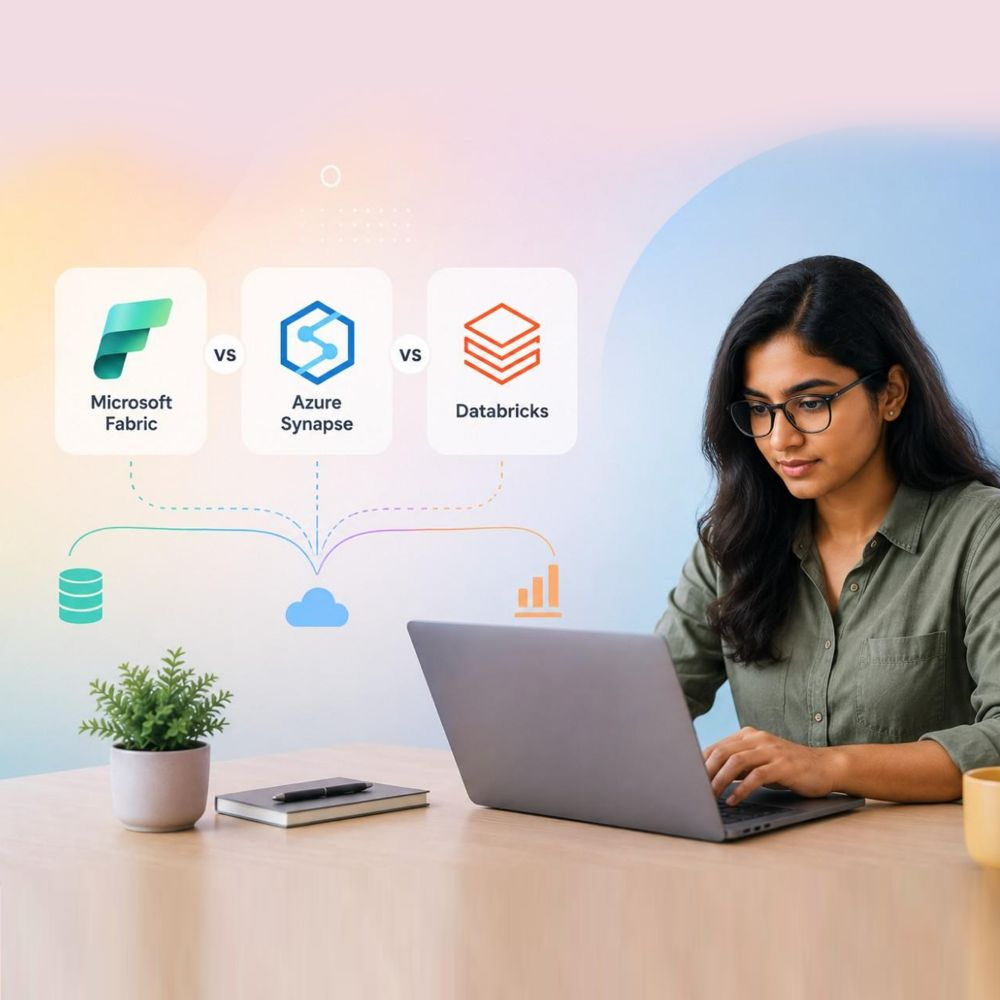
If you've decided to move into data engineering, you've probably hit this wall: three platform names keep appearing everywhere — Microsoft Fabric, Azure Synapse, Databricks — and every job posting seems to want a different mix of them. Learning all three at once isn't realistic. Betting on the wrong one feels expensive.
Here's an honest comparison — including the part most articles skip: what's actually happening to these platforms in 2026, and what Indian job postings really ask for.
Azure Synapse Analytics (launched 2020) was Microsoft's first attempt at a unified analytics platform — SQL data warehousing, Spark processing, and data pipelines brought together as a PaaS offering where you configure and manage the infrastructure components yourself.
Microsoft Fabric (launched 2023) is the next generation of that idea, rebuilt as SaaS. Data integration (Data Factory), engineering (Spark notebooks), warehousing, real-time analytics, and Power BI all live in one workspace, sharing one storage layer called OneLake. Nothing to provision; everything pre-wired. It's the platform Microsoft is betting its data strategy on — Fabric crossed a $2 billion annual revenue run rate in early 2026, with over 31,000 customer organizations and the fastest growth of any analytics
platform.
Databricks is the independent heavyweight — the company that popularized the lakehouse architecture. It's code-first, built around Spark and Python notebooks, runs on Azure, AWS, and Google Cloud, and is the default choice for teams doing serious machine learning alongside data engineering.
This is the part learners most need to understand, and it's where most comparison articles are out of date.
Microsoft has not deprecated Synapse — it remains fully supported, and no shutdown date exists. But the direction is unmistakable: Microsoft's leadership has described Fabric as the next version of Synapse, every new capability (Direct Lake, OneLake, Copilot integration, data agents) is being built on Fabric only, and in 2026 Microsoft released migration assistants that move Synapse pipelines and Spark workloads into Fabric with guided tooling. In practical terms, Synapse is in maintenance mode: stable, supported, but no longer where the future is being built.
What does this mean for you as a learner? Two things that sound contradictory but are both true:
| Microsoft Fabric | Azure Synapse | Databricks | |
|---|---|---|---|
| What it is | Unified SaaS analytics platform | PaaS analytics suite | Code-first lakehouse platform |
| Learning curve for non-coders | Gentlest — visual-first, Power Query-style dataflows | Moderate — more infrastructure concepts | Steepest — notebook and code-centric |
| Power BI integration | Native (Direct Lake) | Connected, but separate | Connector-based |
| Future investment | All of Microsoft's new features | Maintenance mode | Very active, independent roadmap |
| Strongest at | End-to-end analytics in the Microsoft ecosystem | Existing enterprise estates, large tuned SQL pools | Heavy Spark workloads, ML/AI, multi-cloud |
| Typical India employer | Any Microsoft-stack organization | Enterprises with existing Azure estates | Product companies, GCCs, data-heavy enterprises |
Search "data engineer" on Naukri or LinkedIn and read fifty postings. A pattern emerges quickly:
Notice what this means: employers don't hire "a Fabric person" or "a Databricks person." They hire people who can move data reliably on the Microsoft stack — and list whichever tool names their current estate uses. The concepts are the career; the tool names are the keywords.
Learn Data Engineering the Business-First Way
SQL, Azure Data Factory, Fabric & Databricks — one sequence, taught live
View Course Syllabus | Read Google Reviews
Here's our honest answer, and it isn't "all three are great, it depends."
Learn in this order: SQL → Fabric (with Azure Data Factory concepts) → Databricks.
Why Fabric before Databricks: if you're a business professional in India, your likeliest employers run the Microsoft stack, and your existing Power BI or Excel skills plug directly into Fabric — Dataflows Gen2 feels like Power Query, and Direct Lake makes your reports faster without a separate integration layer. Fabric gives you the shortest path from "learning" to "building something your organization can use."
Why Databricks second, not never: Databricks commands a premium in the Indian market — demonstrable Databricks or PySpark experience typically adds 15–25% to compensation — and it's where you'll do the heavier Spark and Python work as you grow. Crucially, Fabric and Databricks are not an either/or: Fabric's notebooks run Spark too, so the PySpark you learn transfers between them, and many enterprise architectures use both — Databricks for heavy transformation, Fabric for the warehouse and BI layer.
Why Synapse doesn't get its own stage: as covered above, you'll absorb Synapse's concepts by learning Fabric and Azure Data Factory. If your first job is at a Synapse shop, the interface differs; the thinking doesn't.
One honest caveat: if you're specifically targeting machine-learning-heavy roles at product companies, the order flips — Databricks first. But that path also demands significantly more Python depth, and it's not where most business-background transitioners should start.
A pattern we see often: learners bounce between platform tutorials — a week of Fabric, a week of Databricks, a Synapse course from 2022 — and end up with surface familiarity everywhere and job-ready skill nowhere.
The platforms differ far less than their marketing suggests. All three move data through pipelines, transform it with SQL and Spark, store it in lakehouse tables, and serve it to reports. Learn that flow deeply on one platform — build something end to end — and the second platform takes weeks, not months. Depth first, breadth second.
The platform question feels high-stakes because it looks like a fork in the road. It mostly isn't. Microsoft has made its direction clear — Fabric is where the ecosystem is going — and the skills underneath all three platforms overlap far more than the product names suggest. The genuinely scarce skill in the Indian market isn't fluency in any one tool; it's the ability to take messy business data and turn it into something trustworthy, end to end.
Pick the platform closest to where you already stand — for most business professionals, that's Fabric — go deep enough to build something real, and let the second platform come to you through work. It will.
Reviewed by the Excelgoodies training team — instructors who have taught Microsoft data tools to 35,000+ professionals since 2006. Platform positions described here reflect Microsoft and industry announcements as of mid-2026; this space moves quickly, so verify current status for major decisions.
Editor's NoteIf You've Picked Your Starting Point
The learning order in this article — SQL first, then Fabric with Azure Data Factory, then Databricks and PySpark — is exactly how the Microsoft Data Engineering course at Excelgoodies is sequenced, taught live and end to end. Built for business professionals making this transition, not for career programmers.
No pressure to enroll today. Explore the curriculum, sit through a session, and decide if it fits.
Because data isn't IT's job anymore. It's yours.
Data Engineering
New
Next Batches Now Live
 Power BI
 SQL
SQL Power Apps
 Power Automate
 Microsoft Fabrics
 Azure Data Engineering
FAQ's
Effectively, yes — over time. Microsoft has positioned Fabric as its strategic analytics platform, all new feature investment goes into Fabric, and migration assistants now move Synapse pipelines and Spark workloads into Fabric. However, Synapse is not deprecated: it remains fully supported, and thousands of enterprises still run production workloads on it, which is why it still appears in job descriptions.
For most business professionals entering data engineering in India, Fabric first — it's visual-first, integrates natively with Power BI, and dominates the Microsoft enterprise ecosystem where most Indian jobs are. Databricks is the higher-premium specialist skill to add second, and the two increasingly appear together in job postings.
Worth understanding, not worth specializing in. Enterprises still run large Synapse estates and job postings still list it, but its concepts (pipelines, Spark pools, SQL warehousing) carry over almost directly to Fabric. Learn the concepts through Fabric and you can work in Synapse environments too.
Fabric is a unified SaaS analytics platform covering integration, engineering, warehousing, and BI in one workspace — visual-first, Power BI-native. Databricks is a code-first akehouse platform with deep Spark, machine learning, and multi-cloud strengths. They compete in some areas but are frequently used together.
SQL appears in nearly every posting, followed by Azure Data Factory/Fabric, Power BI, Databricks/ PySpark, and increasingly Microsoft Fabric by name. Most postings ask for combinations rather than a single platform.